Friday, December 17, 2010
Microsoft and Diddy Teaming Up?
Microsoft and Sean P. Diddy Combs launched a social media holiday campaign this week to get fans involved with giving away thousands of dollars to charities by deciding the beneficiaries without costing them a dime.
For seven days, Sean Combs, also known as P. Diddy, will use Tag to share exclusive content with fans through a link via Twitter and Facebook. More than 3 million Twitter followers and oodles of Facebook Fans also will participate in the giveaway of $10,000 per day for five days. Proceeds will go to five charities.
Diddy uses Twitter to promote the exclusive giveaway, tweeting to followers how to find the content, scan the Tag, and unlock the gift via smartphone, either iPhone, Android, BlackBerry or Windows.
The campaign -- created for Microsoft by Izea, a social media marketing company -- gives $50,000 to charity for twelve days. During the remaining five days, those scanning tags have an opportunity to vote on how thousands of dollars are divvied up to charities.
Izea CEO Ted Murphy, who is responsible for getting Diddy on board, says Tag can more accurately read results and gather backend data compared with a QR code. He calls it the "biggest campaign of its kind" where tweets are sent through a sponsorship in a social media platform.
Marketers can build rules into the platform that only allow each individual to phone scan a tag once hourly to vote for a charity. For each day during the five, site visitors will see a list of three charities to choose from. At the end of the day, Diddy announces the winner. "We're happy to support charitable giving," says Jeff Somers, director of marketing at Microsoft.
Microsoft Tag -- a slightly different technology than QR codes, another 2D barcode -- works in color or custom code images. The technology, which lives within Microsoft's startup and incubator business group, lets marketers continually change the code on the fly to point the URL in another direction, so designers need not hardcode the URL into the campaign. That flexibility aims to encourage testing and increase the lure for marketers.
As for metrics, Tag's backend platform tracks device IDs, so it recognizes the phone type and when the user engages with the tag. This lets marketers create campaigns targeting specific phones. The backend infrastructure, designed as an end-to-end solution, allows marketers to collect data every time a phone engages with a tag. On the backend, a heat map identifies the location of the scans, as more location-based data is built and pulled into platforms.
Thursday, January 14, 2010
Google China To Be Shutdown?
The story of Google choosing to un-censor it's service in China is of course a day old (those late on the news click here). This of course ruffles the feathers of the ancient Chinese government who is still certain their inhabitants are not wise enough to make choices on their own. Apparently in the falling of censhorship, "Tianamen" was a popular search term. I could spend some time going into the things wrong with the Chinese govt on this idea, but I wont. I'm going to take the business route here....
If the reports across the Web today are true that Google.cn may in turn be shutdown due to the egregious offense to not censor their search results, would mean the door swings wide open for a variety of players. The obvious players of Yahoo and MSN are salivating, but what about the upstart community of burgeoning search leaders? I'm hearing quite a bit about Baidu.cn which attracts almost 58% of all searches from China. But thats within it's walls. Googles ability to allow outside access means communication with what is most likely the world's next powerhouse (open that for argument).
Plenty to shake out, but Apple is thrilled according to Fast Company:
Meanwhile there may be one very unexpected techno casualty of a Google China shut down: Android OS. Android has seemed to be making headway in the country, with devices like Lenovo's OPhone, the HTC Magic, and Dell's Mini 3 device on sale. But if Google pulls out, it might hurt how well future Android devices do: Though the OS is effectively an open and free platform, Google's support is essential to pushing its development in the future--and why would Google push next-gen high-tech Android phones like the Nexus One in China if it's so opposed to the way China's government forces it to run its business? The move could even result in a further splintering of Android into China and everywhere-else versions. Would this move then shine more of a spotlight on Apple...which recently introduced a special China-friendly version of the iPhone a, is happy to comply with Chinese restrictions, and has numerous business interests in the country? It's extremely difficult to tell, but it would seem more likely than not.
Thursday, October 30, 2008
Blackberry Game Mimics Real Life Movements...Scary
Courtesy of TechCrunch Mobile:
Its been a few months since we last mentioned Mobile Dead, but this zombie-blastin’ “Mobile Multiplayer Trans-Reality” (MMTR) game has now gone live in New York City.
Like other MMTR games, you’re wandering the streets of your own city rather than some made up fantasy land. Your character and other in game objects are superimposed onto a map of your area, with your character’s position determined by your real-world location (via GPS). Move in the real world, and you move in the game.
Because everything can be made better with a dash of the undead, Mobile Dead takes the MMTR concept and throws zombies into the mix. Weapons and health items are scattered around your area, with on-screen danger lurking behind every corner. As you come across other players (zombies), you’re free to friend them, fight them - or both. According to Perk Mobile, Mobile Dead’s developers, the game will even extend past the screen, with “real world puzzles” and hidden codes placed around NYC.
We noted this briefly last time, but it still holds true: The tough part for Mobile Dead will be maintaining a critical mass of players. If there aren’t enough players in New York City, much of the game’s appeal is lost. Hell, even if there aren’t enough players in any given neighborhoodof NYC - who’s going to trek 8 blocks to try and stalk down an opponent? On the opposite end of things, too many players could spoil the fun. If they do manage to maintain that balance though, Mobile Dead could turn out to be a blast.
Something that might ensure they can at least maintain them minimum would be getting the game onto other mobile platforms. They’re working on it; while there’s no ETA yet, releases are in the works for both Android and the iPhone.
With cell tower triangulation technology growing in popularity and satellite-based GPS well on its way to becoming a fully standard feature, I’d imagine we’ll be seeing a whole lot more of these MMTR games making their way out over the coming months and years. Keep your eye on the genre - it’s easy enough to drop in and out off to be inviting to the casual gamer, while immersive enough to keep it from becoming mind-numbing after just a few minutes.
T-Mobile G1 Coming To Wal-Mart, But Not Yet
Shipping delays have left Wal-Mart shelves bare of the first Android handset, the T-Mobile G1. It was originally reported that the mega-retailer would begin selling the G1 at a discounted price of $148.88 this week, but BetaNews has learned that this is not the case.
“We’ve experienced a few shipping issues, but we’re working with T-Mobile on that,” said Wal-Mart’s Ashley Hardie.
On or around November 3, the G1 phones will be for sale for $148.88 -- approximately $31 less than T-Mobile is charging for them -- at about 550 of Wal-Mart's roughly 4,300 stores, according to Hardie.
In a quick check by BetaNews today, the anticipated G1 phones weren't yet mentioned on Wal-Mart's Web site.
"But we're working with out Web site to put up a list of the stores where the phones will be available, before we starting selling [the G1s]," Hardie told BetaNews.
Wednesday, October 22, 2008
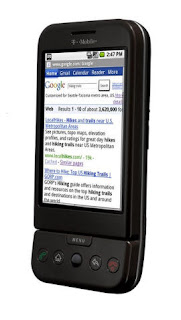
T-Mobile G1 Is Finally Here
T-Mobile said pre-order demand for the new G1 is three times what it had expected and many stores are opening early tomorrow in anticipation of high interest. The company declined to disclose the phone's unit sales projections, but research firm Strategy Analytics estimates G1 sales would reach 400,000 units in the fourth quarter, for a 4% market share.
The G1 has been relentlessly compared to the iPhone; yet beyond their similar touch-screens, there is little else these phones share. The G1 comes tightly knitted to Google services, and a Google account is required for using the phone. At $179 with a two-year voice and data plan, the G1 phone is $20 cheaper than the entry-level 8-gigabyte iPhone. The iPhone has a broader appeal than the G1, analysts said. The iPhone has been positioned as a fashion accessory, as all things Apple are. A testament to its hip but mainstream pedigree, 30% of U.S. consumers who purchased Apple's new iPhone 3G from June through August switched from other mobile carriers to join AT&T, according to market researchers NPD Group. T-Mobile declined to disclose projections for its expected conversion rates with the G1.
Wednesday, October 1, 2008
Adobe To Bring Flash To iPhone
Apple Insider reports that Adobe has said they are close to releasing a version of their Flash player for the iPhone.
Sr. Director of Engineering at Adobe Systems Paul Betlem made mention that the program is nearly finished, however Apple's closely guarded App Store system would have the final say. Should Apple approve the software, it would be available "in a very short time," Betlem added.
Betlam was speaking at the Flash On The Beach (FOTB) conference.
As an iPhone user, I’m sure I’m not alone in saying there needs to be a video capability of some kind for the iPhone beyond the YouTube application, which in my opinion is subpar. Now that the G1 is on its way, despite its wholly unimpressive build and features, there is now competition for the basics that the iPhone provides. The first in the video race will truly set themselves apart as a viable media channel. Until then, the market will continue to stutter in the face of technological roadblocks and a growing content base.
Tuesday, September 23, 2008
T-Mobile G-1 Lives
CNET has a great first impression of the T-Mobile G-1, Google's highly anticipated Android powered phone...
Now that we've had a taste of what the T-Mobile G1 offers, we now compare it with other phones on the market and see if it brings anything different to the table.
1. Design - The combination of a touch screen and a keyboard isn't new of course, but I thought it would be good to remind people that others exist. The HTC Touch Pro is a Windows Mobile device that has both a touch screen and a keyboard, while the LG Voyager is a non-smartphone with both a touch screen and a keyboard as well. That said, the addition of a QWERTY keyboard does make it a little more user-friendly than touch screen only devices like the Apple iPhone or the Samsung Instinct.
2. Interface - Of course, we won't be able to really tell the difference between the G1 and that of other touch screen phones until we get one in our hands, but from the demo, it appears that you use the touch screen just like you would with the others. You swipe the touch screen to switch pages and scroll down menus, and you tap an application to open it. However, you can also hold down something (or a long press) to open up options. Just like the LG Dare, the T-Mobile G1 lets you drag and drop any application to the home screen as a convenient shortcut. Since the G1 runs an operating system made by Google, it only makes sense that it has excellent search capabilities. Just like that on the Helio Ocean, the G1 has something called one-click contextual search, which lets you search your contacts as well as the Web just by typing in a few letters and hitting Enter. We'll know more about the G1's interface once we try it out for ourselves.
3. Connectivity - The G1 is one of the first devices to work on T-Mobile's 3G network. It also works on both WiFi and 3G, and has quad-band GSM plus dual-band UMTS, which means it will work abroad as well. The iPhone has both WiFi and 3G, but only has tri-band GSM, while both the Instinct and the Dare are CDMA with EV-DO and don't have WiFi. The HTC Touch Pro has WiFi, 3G, and a quad-band GSM version, but is not yet available in the U.S. The G1 has Bluetooth but not stereo Bluetooth, similar to the iPhone. Other devices like the Instinct and Dare do have stereo Bluetooth. Also, the G1 does not allow tethering as a modem, which most Windows Mobile smart phones allow.
4. Messaging - Like most other phones, the G1 has email and instant messaging with special preference given to GMail and Google Talk. It doesn't have Exchange support out of the box, which both the iPhone and the Instinct do (and of course every Windows Mobile smart phone out there). But if you're a GMail fan, you'll love the push GMail on the G1. Also unlike the iPhone, the G1 does have multimedia messaging, plus you can multi-task applications while chatting. There's a "windowshade" that you can pull down on the G1 to retrieve an ongoing instant message conversation.
5. Browser - The G1 has a full HTML browser present on most touch screen phones as well as most Windows Mobile smart phones, so there's nothing new there. It has on-screen controls to zoom in and out, which is a different than the pinching method of the iPhone, but quite similar to other devices. You can open multiple pages and share webpages as well. The one difference is that it uses Webkit, an open source browser built to be lean and fast.
6. Location-based services - Here's where the G1 really makes a difference. It comes with Google Maps Street View built-in, providing you with a street view of any location covered with Google Maps. It also comes with compass mode with the scene on the screen moving as you do. No other phone supports this Street View application just yet. It doesn't have applications like Where or Buddy Beacon built-in, but with the Android Market application store, I can't imagine it'll take too long for more location-based applications to be available.
7. Media - One of the big news of the day is that the G1 is the first phone to offer a mobile version of Amazon's MP3 store, providing a viable alternative to the iTunes store on the iPhone. This is major news and the implications of it are far larger than can be covered here. Suffice to say that Apple better watch its back. As for the music player, I'm not sure if it'll provide podcasting support yet, but even if it doesn't, I'm sure a third-party application will be available for it. The G1 also comes with a 3-megapixel camera, which is better than the iPhone's, but otherwise not too groundbreaking. I liked that you can trim and crop the image directly on the phone and then drag and drop the image to the home screen, which is similar to the LG Dare.
These are just a few comparisons I've come up with in the first hour since the G1 announcement. Are there any more that you can think of? Let us know in the comments.
Monday, September 22, 2008
Android Arriving Tomorrow Says Google
Friday, July 11, 2008
Will Customers Understand The gPhone and Android?
Driving into work today, my buddies and I were discussing a coworker, who was at the time standing in line to get the new iPhone. He was making the switch from the Blackberry, and had vowed months earlier to never buy the iPhone. And now he is the first in our office to get the 3G. It wasn’t a huge shock; he works in digital and is a tech savvy individual.
But I started thinking of all the iPhone users who have really struggled to get hold of all the functionality the iPhone offers, as well as adjust to its interface. Apple is the king of user friendly, so it isn’t shocking when you see Baby Boomers dragging their fingers across the iPhone screen. But there has been a grace period for folks to get used to the gadget in their hand.
The expected mayhem of today’s 3G release got me thinking about Android and its future with any potential customers who don’t really understand the system. While driving to Southern California last week to celebrate July 4th, somehow or another a friend and I got to talking about the cell phone market and the gPhone. She is close to completing her education to become a nurse. She is an unbelievably smart young woman, but isn’t in the tech/digital world. After I did twenty minutes on open source and the ideas behind it, she had the glazed look of a media buyer getting trampled by a salesman pounding them with worthless information about reach and “breadth and depth.” Maybe my explanation was off or too long winded, as I tend to be, but the big idea of open source went straight over her head.
So back to my original question (man, it took me awhile to circle back); will the average consumer be aware of the control and power an open source platform like Android offers? Or will it simply fly over their heads and they’ll use it as they would their Motorola Razr? Having not seen the final interface for Android, it’s hard to speculate on how friendly it will be to the non- techie customer segments. But a part of me is very curious if the impact will be as great as it can be or is expected to be. I work in digital and I love gadgets, and even I want to go on a mental diet when reading about the latest open source platforms and gizmos that engineers are working on. It’s not an easy topic at all to wrap your head around, so trying to package it up into a small communication device like a cell phone will be quite a feat.
So Google, give us your best. You’ve done well at capturing Joe American so far. But will you finally get too smart for the average customer? Will they come running the way they do for your email client and shared calendars? Or will they shy away, sheepishly admitting that they just don’t get it. Time will tell.
Wednesday, June 25, 2008
Participatory Media, Open Source, and Android
Wired’s July issue has a fantastic piece regarding the “gPhone” and the Android OS, which really got me thinking about the endless possibilities of an open source platform. The article is titled “Google's Open Source Android Phone Will Free the Wireless Web.”
Google has always been a company about software, not hardware. So when Andy Rubin, the mind behind Google owned Android says there won’t be a gPhone, there will be hundreds, I didn’t bat an eye. But will other key web players follow suit?
The Internet is evolving into participatory media, more and more with each day. There are constantly conversations going on about the Semantic Web, Web 2.0, 3.0 and so forth, yet few companies have come out with a tangible plan to make this future an actuality. Not to say that the change will happen overnight, but I genuinely feel we are getting closer and closer to the technical reality of a personalized web space. And to me, an open source platform is the key to allowing for constant innovation and collaboration. To quote from the piece, “Google wants developers to write programs that draw swaths of users, which in turn attract more developers.” Call me a traditionalist, but I want to believe we are all in this evolution together, and that the Web becomes better and better when smart minds get into a room and talk it out, (or punch it out when necessary).
Even if Apple’s Kleiner- Perkins fund for iPhone app developers allows a some engineering nerds the chance to make a dynamic map software system on my phone, can it really compete with the pssibility of a truly open source platform?

googleresult300DPI_270x477.jpg)